
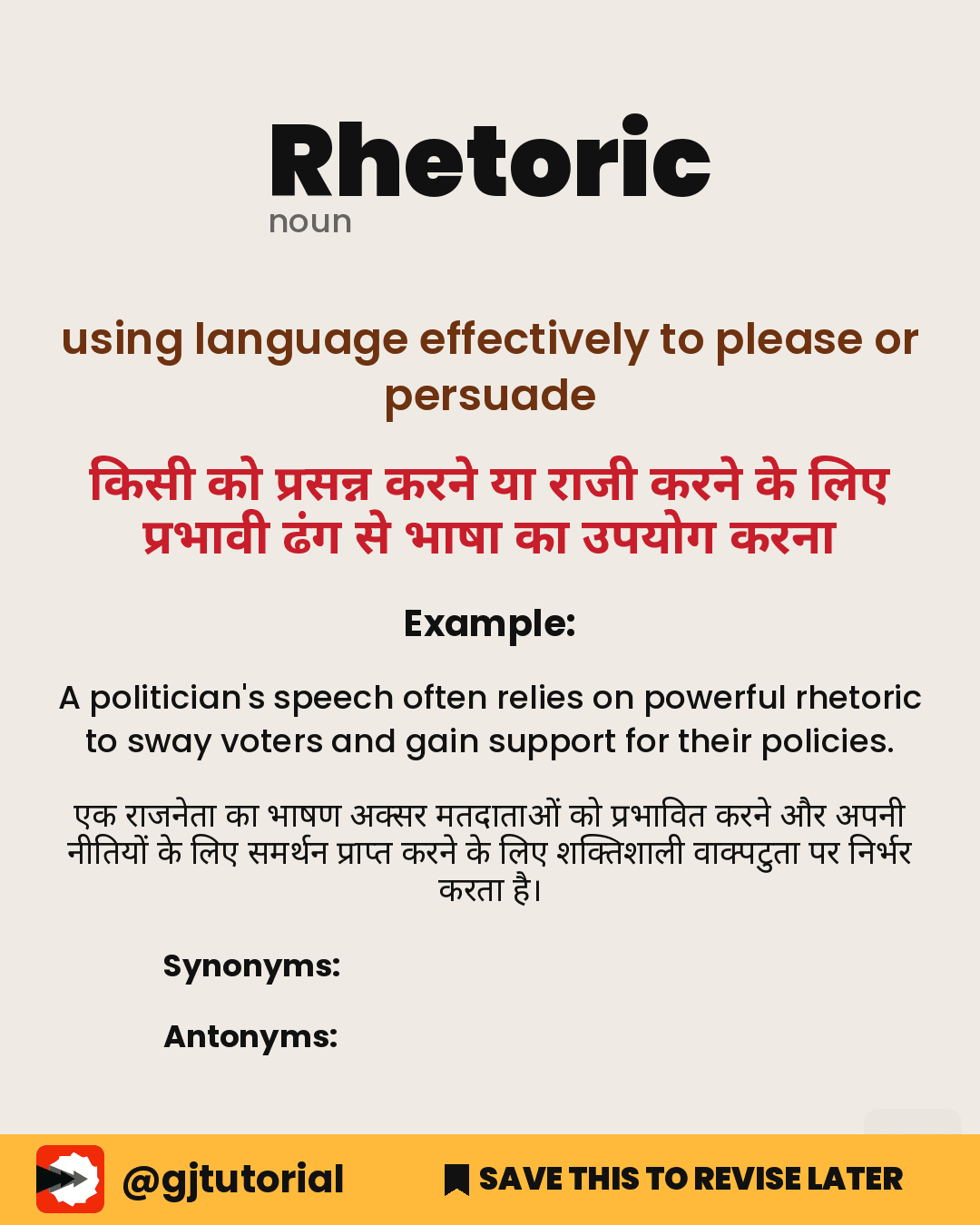
Rhetoric (noun) /ˈrɛtərɪk/
Meaning: using language effectively to please or persuade
Usage: A politician's speech often relies on powerful rhetoric to sway voters and gain support for their policies.
Origin: Rhetoric comes from the Old French 'rethorique', which itself derived from the Latin 'rhetorica' and Greek 'rhētorikē technē', meaning 'art of an orator'.
Exam Trap: Do not confuse 'Rhetoric' (noun) with 'Rhetorical' (adjective). Rhetoric refers to the art of effective or persuasive speaking or writing. Rhetorical describes something relating to or concerned with rhetoric, often used in phrases like 'rhetorical question' which is asked for effect rather than an answer. Exams often test the correct part of speech in fill-in-the-blank or error-spotting questions, where using the adjective instead of the noun, or vice-versa, would be incorrect.
Remember: **Rhetoric** sounds like 'write trick'. Think of a skilled writer using tricks with words to persuade you.
Common Mistake: A common error is misspelling 'Rhetoric' as 'Rhetorik' or 'Rhetoric' (missing the 'h'). Remember the 'h' after 'R'.